Feminist Justice and Introduction of Trauma in Courtroom: Reading Di Lellio and Kraja’s The Strongest Link
By dr. Nevenka Tromp
3 December 2025
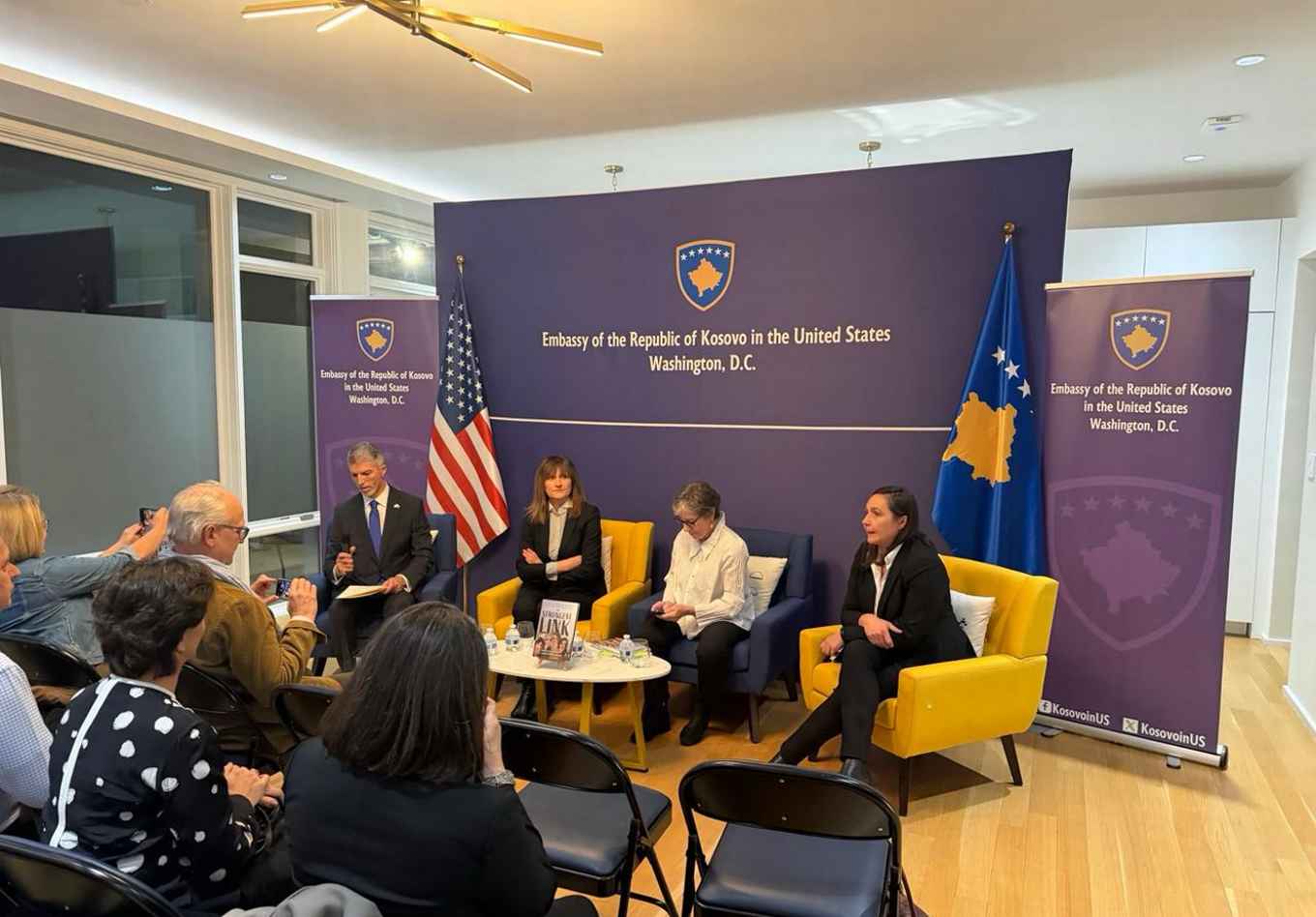
This work thus becomes both a historical reckoning, legal normative issue, and a philosophical opening toward what is known as a feminist approach to justice: a justice that listens, recognises, and holds trauma as truth.
Feminist Justice and the Wavery Hand of Justice
In the framework of feminist justice, if the criminal justice had failed the victim witnesses the failure would be epistemic: it would concern inability of the law to hear the truth of women because it demanded coherence where trauma speaks in fractured emotions and memory lapses. A feminist approach to justice redefines what counts as justice by cantering the lived, emotional, and embodied experiences of women — especially those silenced or marginalized by law, war, and patriarchy. It challenges the limits of traditional (retributive) justice systems, which are focused on perpetrators, procedures, and verdicts, and instead recognizes truth-telling, recognition, and solidarity as essential components of justice. A feminist approach to justice requires reconfiguring not only who speaks in court but how law listens. It calls for transforming the evidentiary culture of justice so that affect, emotion, and truth are treated as forms of knowing.
Di Lellio and Kraja begin with the ICTY’s historic moment: Milošević’s death in 2006 and the subsequent trial of his subordinates. Although sexual assault was recognised as a war crime, the Kosovo indictments produced very thin convictions for rape. There were three trials dealing with the Kosovo related crimes: Milošević, Milutinović et. al., and Đorđević trials. As Milošević died in 2006, the first judgment in the Kosovo-related trials was rendered in 2009 in the Milutinović et al. trial. Of the six defendants, only General Nebojša Pavković, the former commander of the Army of Yugoslavia’s 3rd Army before and during the Kosovo war, was convicted for sexual assaults in the Beleg area. His conviction was based on his participation in a Joint Criminal Enterprise as a high-level military commander who could have foreseen and prevented the sexual assaults. The Appeals Chamber expanded Pavković’s criminal responsibility to other crimes sites: Qirez and Prishtina. It also found more defendants guilty of the sexual assault crimes – for all three areas: Beleg, Qirez and Prishtina. It took the Judgment on Appeal in 2014 to convict also Sreten Lukić, a highly placed police general; and Nikola Šainović, politician in charge of the Kosovo conflict, appointed by that position direvclty by Slobodan Milošević. In 2014, the ICTY Appeals Chamber in Đorđević found that the Trial Chamber had been unduly cautious in its assessment of the two young women from Beleg. On appeal, it held that the sexual assaults were clearly proven, discriminatory in nature, and constituted acts of persecution. Accordingly, the Appeals Chamber entered convictions for persecution through sexual assault in five Kosovo municipalities: Pristina, Peć, Đakovica/Gjakova, Prizren, and Suva Reka.
The Right to Tell: Testimony as Symbolic Justice
At the centre of the chapter stands the protected witness - in De Lellio and Kraja book named Teuta - and her confrontation with Milošević during his cross-examination. Permitted to cross-examine his own victim, he re-enacted the domination that defined his rule, asking, “If it happened to you, do you have any proof besides your statement?” Teuta’s reply - “I did not come here to lie. That happened. I’m not here to lie. That is true.” - was an act of existential defiance. In that moment, justice shifts from verdict to voice. Even without conviction, the act of telling becomes juridical: a restoration of dignity through the assertion of truth. Scholars described this process as the ‘justice of recognition’ - a justice form that regards listening and acknowledgment as reparative acts in themselves. Yet, many survivors told Di Lellio and Kraja, that they did not experience their testimony as narration they could control. Their stories were mediated by prosecutors, translators, and legal codes that were there to transform human suffering into legal argument. The courtroom became a site where their words were extracted, structured, and repurposed - and very rarely a space where they could claim authorship over their own truth.
Toward a Feminist Ontology of Law
In earlier international justice moments - most famously the Eichmann trial - trauma entered the courtroom for the first time. This was called the Age of Witness Evidence. In The Strongest Link, women’s testimonies extend that legacy: justice thus evolves from a verdict to an existential and transformative event. As Teuta said, “I was liberated a little, but again it all came back.” Liberation and recurrence coexist; justice is no longer closure but continuance - the refusal to let silence speak. Teuta’s story shows that there is a tension between testimony and verdict, between recognition and repair. It shows how the feminist approach to justice has been shaping up into a feminist ontology of law - one that represents justice not as domination or retribution, but as the ethical act of hearing trauma into being. In that sense, The Strongest Link stands as both history consisting of voices of the ordinary people and deliberative justice: a record of women’s truth expressed thought institutional language and heard wide and loud by the global audience. It emancipated suffering from the intimate private hiding places to the public deliberative global stage. This became a call for a new legal epistemology grounded in openness, empathy, embodiment, and recognition. Teuta’s story is not merely evidence; it is ontology. It is justice made public, archived, and audible.
From Institutional Extraction to the Fourth Wave of Feminist Justice
By the book’s end, Di Lellio and Kraja reveal the painful paradox of institutional justice: the prosecutors “beg” Teuta to return because the credibility of their case depends on her pain, yet the system offered her no emotional protection. Justice becomes extractive, living off women’s trauma. By identifying that the feminist reconstruction of justice addresses ‘re-traumatisation’. the authors argue for more space for facilitating the trauma as evidence by more care, regard, and sensitivity regarding victim witnesses. This shift aligns with the broader Fourth Wave of Feminism, which has transformed sexual violence from private shame into global public discourse. Movements such as #MeToo and Time’s Up, together with post-war truth commissions and people’s tribunals from the Balkans to Africa, have redefined justice as a participatory, deliberative, and narrative process. In this wave, testimony destigmatises survivors and reclaims the agency by those who suffered. In this global feminist continuum, the voices of Kosovo’s women, as collected by Di Lellio and Kraja, mark a crucial juncture: the stories they recorded were told timely. This time world is ready to listen. By enabling the ‘truth’ of victims and survivors to resonate through legal discourse, in a world still shaped by the visible and invisible rules of patriarchy, this book achieves something monumental.
- Source: Anna Di Lellio and Garentina Kraja, The Strongest Link: An Oral History of Wartime Rape Survivors in Kosovo (Oxford University Press, 2025).