Parliament of Parallel Futures: Rebuilding Europe’s Institutional Imagination
- Date
- 21 March 2026
- Time
- 12:00 -18:00
- Location
- IMPAKT — Centre for Media Culture
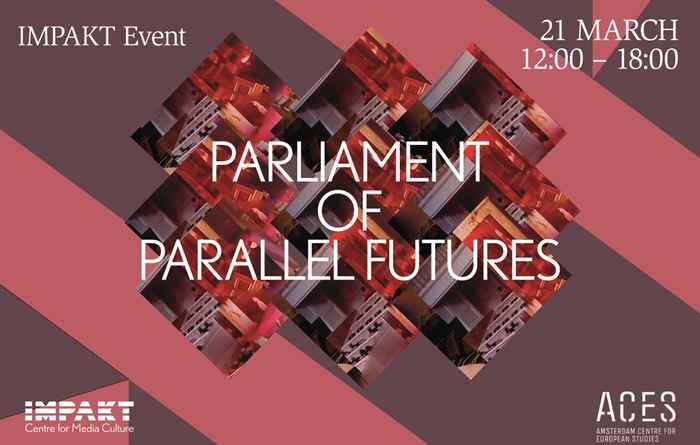
Parliament of Parallel Futures brings together artists, architects, designers, and researchers who approach institutions not only as stable political structures but also as cultural and spatial forms that can be critically reimagined.
Across imagined museums, agonistic assemblies, diagrammatic chambers, and curatorial pavilions, the event explores how Europe’s democratic architectures might be examined, staged, and reconfigured through artistic and design practices. Rather than treating institutions as fixed frameworks, the contributors engage them as sites of experimentation—testing how authority, representation, and collective decision-making might be organised differently.
Each contribution activates a temporary “parliament” within the space: a concrete arrangement of objects, diagrams, and presentations that invites reflection on the symbolic and spatial dimensions of democratic life. The programme moves from analyses of existing institutional landscapes toward more speculative methods for rethinking them. In the afternoon, the discussion opens into a participatory lab where participants sketch and test their own unreal institutions.
Developed in collaboration with ACES, the event situates artistic and design research within broader debates about the future of European democracy and the forms through which political imagination is organised.
Ticket information
The event is free for University of Amsterdam staff and students. The UvA community can join the event for FREE using the discount code: 'uva2026!'.
About the speakers
Lore Gablier — Curator
Lore Gablier works at the intersection of art, culture, and the question of Europe, focusing on how collective imagination shapes societies. Since 2015 she has been Project Manager at the European Cultural Foundation in Amsterdam, where from 2020 to 2025 she designed and implemented The European Pavilion, an artistic initiative on Europe and its possible futures. Trained in fine arts and curatorial practice, she has initiated and led projects and publications that bring together contemporary art, collective practices, and societal questions, both as a freelancer and within institutional contexts.
Markus Miessen — Architect
Markus Miessen is an architect, writer, and Professor of Urban Regeneration at UniLu, where he holds the Chair of the City of Esch. He has previously taught at the AA, The Berlage, Städelschule, USC LA, and has been a Harvard Fellow. His work revolves around questions of critical spatial practice, institution building, and spatial politics. As a spatial consultant, he currently works with the Munich Documentation Center for the History of National Socialism. Among his many publications are The Nightmare of Participation, Crossbenching, and the edited volumes Agonistic Assemblies and Reflections on Democracy and Urban Form. Since 2024 he has also been part of the Dean’s Visiting Faculty at Columbia GSAPP in New York.
Pete Fung — Designer
Pete Fung is a designer, researcher, and educator based in the Netherlands. His practice explores how design can be used to critically engage with the complexities of our interdependence: the languages we use, the aesthetics we subscribe to, the institutions we inhabit, and the ways in which we relate to them. His work has been exhibited and published at MIT Press, Kunsthal Aarhus, Helsinki Design Museum, Jan van Eyck Academie, Onomatopee, among others. He is currently a design resident with Nieuwe Instituut and cheFare in Milan, and teaches in the MA Social Design at the Design Academy Eindhoven.
Thomas Bellinck — Theatre maker
Thomas Bellinck is a Brussels-based artist whose audio-based work focuses on memory politics, border violence, and practices of incarceration. He is a founding member of theatre company Steigeisen, the artistic production platform ROBIN, and The School of Speculative Documentary. In 2013 he created Domo de Eŭropa Historio en Ekzilo, a futuristic-historical museum about life in the former EU. Since 2015 he has been developing Simple as ABC, a series of performances and installations about the EU border regime, including an interview musical on surveillance technology and an evolving human-hunting museum. Most recently he created the opera Barzakh, in collaboration with people detained in several Belgian prisons.
David Mulder van der Vegt — Architect
David Mulder van der Vegt is an architect and researcher, and co-founder of the Amsterdam-based architecture practice XML. His work examines the spatial and diagrammatic logics through which political institutions are organised and represented. At XML he has developed a series of research projects and publications on the architecture of governance, including The Parliament, a comparative study of parliamentary buildings and their spatial typologies. Through exhibitions, books, and installations, his work investigates how institutional space shapes political processes, collective deliberation, and public representation.